
Six Banks in the Turkish Financial Sector Lead the Way towards a Sustainable Future
The Principles for Responsible Banking, launched by the United Nations Environment Programme Finance Initiative (UNEP FI) and joined by 130 founding-signatory banks worldwide with combined assets exceeding USD 47 trillion, were unveiled at the United Nations General Assembly meeting held in New York on September 22. Among the banks committing to implement the UN Principles for Responsible Banking, Garanti BBVA, ING, Development and Investment Bank of Türkiye, Şekerbank, TSKB and Yapı Kredi assumed a global responsibility from Türkiye that would set an example for all sectors in sustainability.
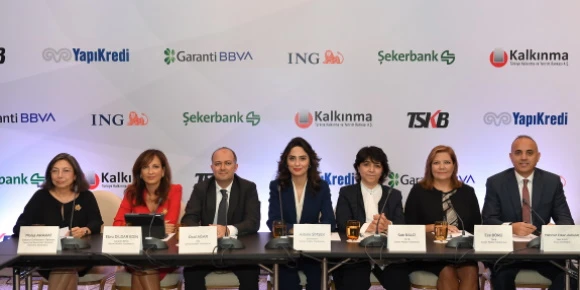
The six leading Turkish financial institutions that signed the Principles for Responsible Banking drew attention to the importance of the issue by holding a joint press conference to explain how the transformations to be carried out across all banking processes would contribute to society and a sustainable future. The meeting was hosted by Ebru Dildar Edin, Executive Vice President of Garanti BBVA; Öcal Ağar, Executive Vice President of ING Türkiye; Satı Balcı, Executive Vice President of Development and Investment Bank of Türkiye; Aybala Şimşek, Executive Vice President of Şekerbank; Ece Börü, Executive Vice President of TSKB; and Mehmet Erkan Akbulut, Group Director at Yapı Kredi, with the participation of Melsa Ararat, Sabancı University faculty member and Director of the Corporate Governance Forum.
“The Principles for Responsible Banking Were Developed through the Joint Work of Banks Including Garanti BBVA from Türkiye”
Ebru Dildar Edin, Executive Vice President of Garanti BBVA—one of the 30 founding banks that developed the Principles for Responsible Banking—provided information on the initiative and the Bank’s sustainability work:
“Approximately two years ago, the United Nations Environment Programme Finance Initiative took action to establish a common roadmap for banks in this field. It invited 30 banks from around the world to draft the Principles for Responsible Banking. The principles were developed through the joint work of these banks, including Garanti BBVA from Türkiye. For nearly two years, we consulted more than 500 stakeholders and worked on how to implement the six principles. On September 22, we opened the principles for signature at the United Nations General Assembly. On the very first day, 130 banks signed. In terms of total assets, these banks represent one-third of the global banking sector. Six banks from Türkiye seated at this table also committed to complying with the principles.”
“We Are Proud to Be One of the 30 Founding Banks That Contributed to the Creation of the UN Principles for Responsible Banking”
Speaking on behalf of ING, one of the banks committed to implementing the Principles for Responsible Banking, Executive Vice President Öcal Ağar said: “As ING Group, we are proud to be one of the 30 founding banks that contributed to creating the UN Principles for Responsible Banking. During a journey in which we have prioritised sustainability for more than ten years, we have voluntarily adopted the Equator Principles since 2003 for financing all projects of USD 10 million or more. As ING Group, we also framed our work through the Terra approach announced last year. We recently published the first report of this initiative, under which we develop a climate-alignment roadmap for each sector and assess the sectors’ climate performance. At ING Türkiye, within this framework, we consider social responsibility and environmental risks in project finance and act in line with the relevant principles. The financial sector possesses the resources to take actions capable of making a difference on the path to sustainability. We believe we must work together with other banks to succeed in combating climate change. Through this cooperation, we will support the transition to a sustainable world.”
“For 44 Years, We Have Supported Our Country’s Development through the Projects We Finance, and We Continue Working with This Mission”
Addressing the importance of the Principles for Responsible Banking for a sustainable future in the financial sector, Satı Balcı, Executive Vice President of Development and Investment Bank of Türkiye, said: “As Development and Investment Bank of Türkiye, our fundamental approach is sustainable development, and our Bank finances projects that serve this understanding. By signing the Principles for Responsible Banking, we confirm the activities we have carried out to date for sustainable development and a sustainable future, while assuming an important responsibility to accelerate this work.”
Drawing attention to the breadth of the sustainability agenda and the depth of the vision of the future shaped by this awareness, Satı Balcı stated that sustainable approaches were gaining importance as the effects of climate change became increasingly apparent, that new concepts had begun to enter daily life and that further concepts would emerge in the years ahead. She added that she believed the signatures made that day would deepen sustainability work in the financial sector and play an important role in shaping new concepts.
Aybala Şimşek: “We Have Played a Leading Role in Financing Sustainable Development for 66 Years”
Aybala Şimşek, Executive Vice President of Şekerbank—one of the 130 banks worldwide participating as founding signatories of the Principles for Responsible Banking—emphasised that the principles, signed by one-third of the global financial sector, had the power to transform the world economy. Şimşek continued:
“The UNEP FI Principles for Responsible Banking provide a global framework for all participating banks, although each bank is expected to implement them in the context of its own strategy. As a bank that has played a leading role in financing sustainable development for 66 years since its establishment and has broken new ground in this field, we view responsible banking as a legacy inherited from the Anatolian farmers who founded our Bank. Through the broad distribution of our lending and our extensive branch network in rural areas, we work to improve the welfare of hundreds of thousands of households and support rural development and production.”
Şimşek stated that Şekerbank had provided more than TRY 1 billion in energy-efficiency financing through EKOkredi, Türkiye’s first energy-efficiency financing product, enabling nearly 109,000 people to benefit from energy savings, preventing 6.4 million tonnes of CO₂ emissions and achieving energy savings of 30 billion kWh. Emphasising that sustainable development offered the sector an important opportunity to access alternative sources of funding, she said: “Thanks to the success we achieved through EKOkredi, we have secured 45% of the external funding on our balance sheet for financing energy-efficiency and renewable-energy investments.”
Aybala Şimşek added that the global financial sector had important responsibilities in preventing ecosystem loss, an issue as important as combating climate change, and that Şekerbank had undertaken a significant mission to increase and encourage agricultural production. She said: “Meeting the food needs of a growing population is one of the most prominent global sustainable-development issues. As a bank established to finance sustainable agriculture, we work with all our strength to help Türkiye achieve its objectives for supporting rural development and increasing agricultural production. In this context, through ‘Family Farming Banking’—a first in Türkiye and the world whose principal objective is to prevent migration from rural areas to cities—we provided TRY 8 billion in financing to 109,000 farming families over more than four years. Today, as a bank allocating 58% of its total loan portfolio to SMEs and reaching more than 350,000 farmers across Türkiye, we will continue developing our unique lending processes to broaden access to finance and prosperity and create greater value for people, society and the environment.”
“Approximately Three-Quarters of Our Loan Portfolio Consists of Sustainability-Themed Investments”
Ece Börü, Executive Vice President of TSKB, another founding signatory of the Principles for Responsible Banking, said: “As a bank that has worked with a mission of sustainable and inclusive development for 70 years, we finance investments that produce while protecting the future, and we assess the environmental and social risks of every project, regardless of its size. Today, approximately 73% of our total loan portfolio consists of environmental and social-themed investments such as renewable energy, energy and resource efficiency, environmental investments, women’s employment, support for priority development regions, and occupational health and safety. In addition to funds secured from global development finance institutions, we create additional resources for these investments through sustainable bonds, in which we pioneered the market in Türkiye. We are pleased to state that, through all these activities, TSKB directly contributes to 14 of the 17 Sustainable Development Goals. While supporting our country’s transition to a low-carbon economy through the investments we finance, we also make a difference through in-house sustainability practices and have completed our tenth year of carbon-neutral banking. We also consider it extremely important for banks to act together to establish a financing approach that helps prevent climate change and protect natural resources. The Principles for Responsible Banking introduced by UNEP FI, which we joined in 2009, constitute an excellent example in this respect. We are very pleased to participate as a founding signatory in such a collaboration with leading banks from Türkiye and around the world.”
“Becoming a Founding Signatory of the UNEP FI Principles for Responsible Banking in the Year Yapı Kredi Celebrates Its 75th Anniversary Holds Special Meaning for Us”
Mehmet Erkan Akbulut, Group Director at Yapı Kredi, one of the signatory banks, said: “Committing to the UNEP FI Principles for Responsible Banking as a founding signatory in the year we celebrate our 75th anniversary holds special meaning for us. We have been included in the Borsa İstanbul Sustainability Index since 2014 and have been a signatory to the Global Compact Türkiye Sustainable Finance Declaration since 2017. We have also transparently disclosed our environmental and social performance to the public through our sustainability reports since 2011. Therefore, for Yapı Kredi, the Principles for Responsible Banking do not mark the beginning of our sustainability journey; they provide a complementary framework. As founding banks signing the principles, we want to respond to the needs of society, our stakeholders, investors, customers and especially future generations. In this context, I believe the principles will guide our Bank and our sector in creating sustainable value for all stakeholders and future generations.”
About the United Nations Principles for Responsible Banking
The principles establish a roadmap for the banking sector—which represents two-thirds of global finance worldwide—to support sustainable development and a better future. They also form the fundamental framework for the sustainable banking system of the future. By defining and shaping the banking sector’s place in 21st-century society and the economy, the Principles for Responsible Banking aim to maximise the sector’s impact in helping societies achieve a sustainable, equitable and prosperous future.